The Crimp Tube Tell: Five Little Flaws That Scream 'I Made This Myself' (And How to Fix Them)
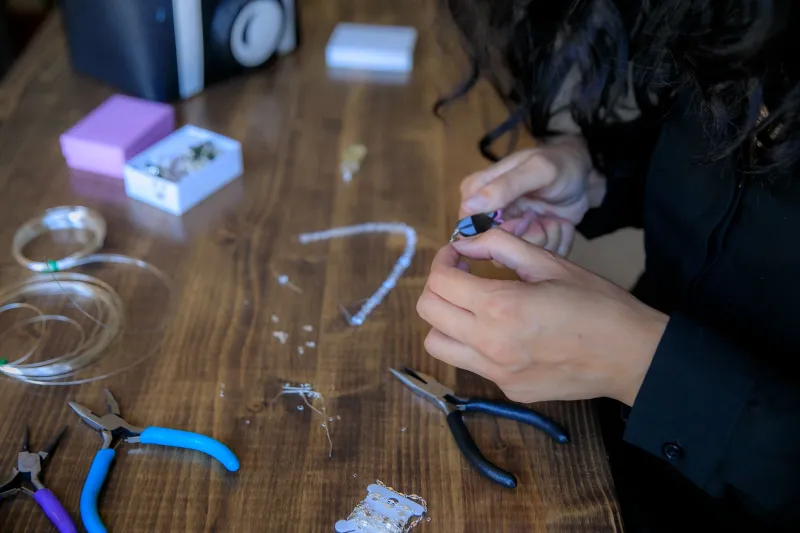
Let's be honest with each other for a minute. We've all picked up a finished bracelet, held it to the light, and thought, oh no. Not broken. Not unwearable. Just... visibly homemade. There's a difference between handmade and homemade, and it usually comes down to five small things that nobody teaches you because every tutorial ends the moment the last bead goes on.
I've made every single one of these mistakes. Multiple times. So consider this the pep talk and the intervention you didn't ask for.
Flaw #1: The Exposed Crimp Tube
This is the big one. The crimp is the single most common tell, and it's a shame because it's also the easiest fix. A bare, squashed metal tube sitting there like a bug on your stringing wire instantly reads "first project."
The fix is two-fold. First, use crimp covers — those little C-shaped beads that snap over the flattened tube and turn it into what looks like a regular round spacer bead. They cost about two dollars for a hundred. There is no excuse. Second, learn the two-step crimp: pinch the tube in the back groove of your pliers first to separate the wires, then squeeze it smooth in the front groove. A properly done crimp is nearly invisible. A badly done one is a tiny crushed soda can.
Flaw #2: Uneven Wrapped Loops
Wrapped loops are what separate a dangle earring that survives a night out from one that ends up in the bottom of your purse, detached and alone. The tell is a loop that looks like a lollipop — a big open circle with a sad little stem.
Here's my trick: after making the initial bend over your round-nose pliers, grip the loop tail with your chain-nose pliers and wrap the remaining wire down the stem away from you, keeping tension the whole time. Two or three snug wraps, tucked close together, then trim and press the end flat. If your wraps look like a spiral notebook, slow down. Consistency beats speed every time.
Flaw #3: Wrong Wire Gauge for the Job
I see this constantly at craft fairs and in Facebook group photos: delicate 0.014-inch stringing wire holding a chunky statement necklace. The wire doesn't fail on day one. It fails three months later, in the middle of your niece's graduation party, and then everyone's picking beads off the floor.
Match the wire to the weight. Lightweight earrings and dainty bracelets can use the thin stuff. Anything with gemstones, glass, or real heft — go 0.019 or 0.024. And if a piece has any actual weight to it, crimp twice. One crimp tube holding a pound of amethyst is a bet you will lose.
Flaw #4: The Mystery Knot
Nothing screams homemade like a knot that's doing structural work and knows it. A big bulky square knot with whiskery ends poking out of a stretch bracelet? We can all see it.
For stretch cord, use a surgeon's knot and hide it — pull the knot inside a bead so it disappears entirely. For knotted silk or nylon, practice the double half-hitch between beads so the knots are consistent and tucked. A hidden knot is craftsmanship. A visible one is a confession.
Flaw #5: Inconsistent Bead Tension
This one's sneakier because it's not a single component — it's the overall rhythm of the piece. Gaps between beads that vary from hairline to canyon. A necklace that doesn't drape because it's strung too tight. A bracelet that's so loose the beads slide around to the underside of your wrist.
Before you crimp anything, lay the strand flat and check the drape. String, then stretch the strand gently and let it settle. Leave about a millimeter of give per inch for movement. Your finished piece should look relaxed, not clenched.
The 60-Second Pre-Wear Checklist
Run every piece through this before you wear it, gift it, or post it:
- Crimps: Covered or properly flattened? Tug test passed?
- Loops: Fully wrapped, no gaps, no sharp wire ends?
- Wire: Heavy enough gauge for the bead weight?
- Knots: Hidden inside a bead, glued, and trimmed clean?
- Drape: Laid flat, does the strand hang evenly with no weird gaps?
That's it. Sixty seconds, five checkpoints, and the difference between a piece that looks like a gift and one that looks like a craft project.
Here's the thing I actually want you to take away: none of this is about perfection. Handmade jewelry is allowed to have a personality. But these five flaws aren't personality — they're just habits nobody corrected. Fix them once, and they're fixed forever. Your future self, mid-party with an intact necklace, will thank you.